Email Marketing
Are Templates Dead? Adaptive Emails Powered by AI
For years, email marketers relied on templates — polished, reusable designs that promised consistency and speed.
Nukesend Team
Author
4 min
Read Time
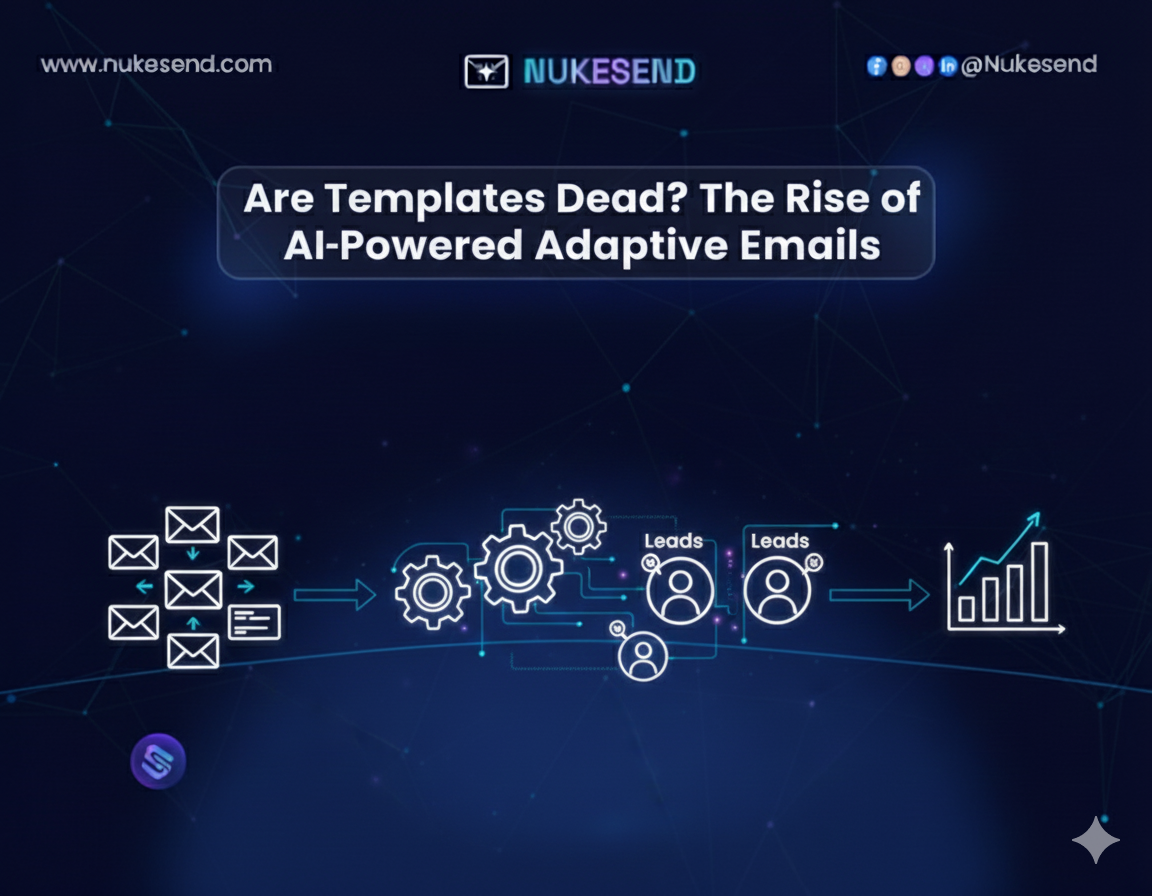
For years, email marketers relied on templates — polished, reusable designs that promised consistency and speed. But in 2025, the inbox has changed. Customers no longer respond to static content. They expect personalized, real-time communication that adapts to who they are, what they’ve done, and what they need next.
So, are email templates really dead? Not exactly — but they’re evolving fast. Let’s explore how AI-powered adaptive emails are reshaping everything we know about digital communication.
The End of Static Templates
Traditional email templates were once a game-changer. You could build, design, and send newsletters faster than ever. But as audiences became more tech-savvy, these templates began to feel repetitive, predictable, and impersonal.
Every recipient received the same structure, same visuals, same tone — even if their interests, buying stage, or context were completely different.
The result?
- Declining open rates.
- Low engagement.
- High unsubscribe rates.
Today, the world runs on data and personalization. When every social post, video, and ad feels “custom,” your subscribers expect the same from email. That’s where adaptive technology comes in.
The Rise of Adaptive Email Systems
Adaptive emails are not just responsive to devices — they’re responsive to people.
Instead of using a static layout, adaptive emails leverage artificial intelligence (AI) and machine learning (ML) to change the content, visuals, and timing based on user behavior and context.
Think of them as living emails — ones that evolve with your recipient.
- The subject line may change based on open history.
- The call-to-action may differ depending on user intent.
- The product recommendations adapt to browsing behavior.
Unlike responsive design (which ensures good appearance across devices), adaptive systems ensure relevance across experiences.
Platforms like Superhuman, HubSpot, and Regie.ai are already proving that adaptive intelligence is the next logical step in email evolution.
How AI Is Transforming Email Creation
A decade ago, most email automation relied on rule-based systems: If a user clicks X, send Y.
Now, AI eliminates the need for manual triggers. Using natural language processing (NLP), predictive analytics, and generative models, emails are generated, tested, and refined automatically.
Examples of this transformation:
- Tone Adaptation: NLP tools (like those in HubSpot or Selzy) can rewrite content to match your brand voice while keeping the message personalized.
- Real-Time Offers: Adaptive emails show live prices or limited-stock alerts using data feeds.
- Predictive Targeting: ML systems forecast who’s most likely to click or convert — and deliver emails accordingly.
In short, AI takes over the heavy lifting while marketers focus on strategy and storytelling.
Real-Time Personalization: The Future of Engagement
The most powerful adaptive systems go beyond simple personalization (“Hi John”). They use real-time data to adjust every aspect of an email.
Imagine this:
- A retail brand sends an email at 9 AM, but the content changes by noon based on live inventory.
- A SaaS platform like Superhuman tweaks onboarding emails depending on how a user interacts with the product.
- A cybersecurity firm like Proofpoint updates pre-delivery security insights dynamically as threats evolve.
This level of personalization drives remarkable engagement. Studies show that AI-powered adaptive campaigns can boost open rates by up to 40% and click-throughs by 25% or more, compared to static templates.
How Adaptive Emails Work Behind the Scenes
So how does all this magic actually happen? How do emails know what to show, when to send, and who to engage — almost as if they were written personally for each reader?
The secret lies in a powerful cycle of data, prediction, generation, and feedback. Adaptive email systems use this continuous loop to learn, evolve, and improve with every send.
Data Collection — Learning from Every Interaction
The foundation of adaptive intelligence is data. Every time a subscriber opens an email, clicks a link, scrolls through content, or makes a purchase, AI tools record these micro-interactions.
Platforms like Relevance AI and HubSpot serve as the backbone for this stage. Their AI agents track:
- Behavioral patterns (what users click, ignore, or engage with).
- Engagement metrics (open rates, dwell time, device type).
- Transactional data (past purchases, cart abandonments, preferences).
- Contextual cues (location, time zone, or even mood based on tone).
All this data feeds into a unified behavioral profile for each subscriber — a dynamic identity that constantly evolves with every action.
In other words, your inbox becomes a reflection of your digital self.
Prediction — Anticipating What Works Best
Once the data is collected, machine learning (ML) models step in to make sense of it. These algorithms identify hidden patterns that humans might miss — predicting what kind of email will perform best for each recipient.
For example:
- If a user tends to open emails with short, action-oriented subject lines, the system adapts future messages accordingly.
- If someone engages more with visual-heavy layouts, AI designs similar structures for them.
- If a user usually clicks morning discounts but ignores evening newsletters, the send time adjusts automatically.
It’s like having a digital marketer who knows every subscriber personally — and never forgets a single insight.
By using predictive analytics, adaptive emails stop guessing and start anticipating.
Generation — Creating Personalized Content on the Fly
Once AI knows what will work, it shifts from prediction to creation. This is where Natural Language Generation (NLG) and Generative AI come into play.
Modern adaptive systems can generate:
- Subject lines that align with user emotion or behavior.
- Body text written in a tone the reader prefers — informative, friendly, or professional.
- Visuals and layouts tailored for each device, demographic, or brand guideline.
- Dynamic recommendations, such as live pricing or personalized product suggestions.
Platforms like Mailjet (Sinch) and HubSpot’s AI Email Generator use this real-time generation to create emails that are not just personalized — but context-aware.
Each message is built from scratch, customized in milliseconds before it reaches your inbox. No two emails are ever the same.
Feedback — The Continuous Learning Loop
After an adaptive email is sent, the story doesn’t end — it starts again. The system measures how recipients respond:
- Did they open it?
- Did they click?
- How long did they engage?
- Did the interaction lead to a conversion?
This data loops back into the model, updating user profiles and improving future predictions.
It’s a self-reinforcing feedback cycle — every email sent makes the next one smarter. Think of it like a coach that learns your strengths and weaknesses after every game. Over time, your strategy becomes sharper, your results better, and your connection stronger.
The Role of Human Creativity — The Secret Ingredient
For all its brilliance, AI still needs direction. As Selzy insightfully points out, “AI amplifies creativity, but marketers define its direction.”
AI can analyze data, test ideas, and even write copy — but it’s humans who decide what story to tell, what emotion to evoke, and what values to highlight.
The most successful campaigns come from human-AI collaboration, where:
- AI handles the repetitive tasks — segmentation, optimization, and testing.
- Humans guide the vision — storytelling, empathy, and brand voice.
This partnership ensures that adaptive emails are not just intelligent, but also authentic.
Because in the end, technology may power the message — but human insight gives it meaning.
Benefits Beyond Personalization
Adaptive emails do more than just “feel personal.” They fundamentally change how organizations connect with people.
Performance That Scales
AI-driven personalization leads to higher open, click, and conversion rates. Dynamic campaigns outperform templates in nearly every industry.
Efficiency and Speed
Tools like Trimbox and Mailjet’s AI Email Generator automate copywriting and design, reducing campaign creation time by over 70%.
Consistency and Brand Alignment
AI ensures every version of your email matches your tone, brand voice, and design language — something human teams often struggle to scale manually.
Smarter Security
Companies like Proofpoint use AI not only for engagement but also for adaptive threat detection — spotting phishing and malicious URLs before emails even reach the inbox.
Tools Leading the Adaptive Revolution
Behind the rapid evolution of adaptive email marketing are a new generation of tools and platforms that seamlessly blend AI, data analytics, and user experience design. These tools are not just automating emails — they’re reinventing how brands communicate, optimize, and personalize at scale.
Here are some of the key innovators driving this transformation:
Superhuman – The AI-Native Email Experience
Superhuman is redefining what an email client can do. Built from the ground up with AI, it continuously learns from every user interaction — from how quickly you respond to who you prioritize in your inbox.
Its adaptive algorithms can:
- Prioritize your most important messages automatically.
- Suggest responses that match your tone and writing style.
- Optimize your workflow with shortcuts and reminders powered by behavioral learning.
Superhuman doesn’t just help users manage email — it turns communication into a personalized productivity experience. For businesses, it offers insight into response patterns, engagement trends, and timing optimization, turning routine email into a performance advantage.
Proofpoint – Adaptive Security Meets Intelligence
In an era where cyber threats evolve faster than ever, Proofpoint leads the charge in adaptive email threat protection. Its AI-powered system uses large language models (LLMs) and behavioral detection algorithms to analyze billions of messages daily.
Key innovations include:
- Adaptive Threat Intelligence: Constantly updated models identify phishing attempts, social engineering, and malicious URLs before delivery.
- Contextual Learning: The system adapts to organization-specific communication patterns to catch anomalies in tone, language, or sender behavior.
- Pre- and Post-Delivery Protection: Proofpoint’s adaptive AI ensures every stage of email interaction remains secure — from inbox to reply.
This blend of adaptive intelligence and protection ensures trust, personalization, and safety co-exist — a crucial factor for modern enterprises.
HubSpot – AI-Powered Personalization at Scale
HubSpot’s AI-powered email platform brings generative intelligence into the marketing workflow. Marketers can instantly generate branded emails, personalized subject lines, and dynamic CTAs without needing external tools or templates.
What makes HubSpot stand out is its AI Optimization Engine, which learns from every campaign’s data:
- It identifies what time users are most likely to engage.
- It auto-adjusts design and layout for better readability.
- It predicts which segments will respond to specific content types.
By merging CRM insights with adaptive email intelligence, HubSpot helps businesses send the right message, to the right person, at the right time — every time.
Stripo – Intelligent Email Design Automation
Stripo has revolutionized email design with AI-driven creative automation. It simplifies the production of high-quality visuals and templates that adapt to campaign goals, brand colors, and tone.
Its AI features include:
- Automated Layout Generation: Build design-ready templates in seconds.
- AI Image Optimization: Compresses and enhances visuals for faster load times and better mobile rendering.
- Font and Branding Intelligence: Ensures every design element matches your identity.
For design teams and marketers, Stripo bridges creativity with automation, proving that AI can enhance human design — not replace it.
Mailjet (Sinch) – Smart Templates and Predictive Copy
Mailjet’s AI suite focuses on adaptive campaign generation — from crafting high-performing subject lines to generating entire email layouts with a single prompt.
Its AI Email Template Generator and Subject Line Assistant rely on predictive models trained on millions of successful campaigns. These models:
- Predict which word patterns will yield the highest open rates.
- Suggest CTA language tailored to audience intent.
- Automatically A/B test variations for real-time optimization.
With Sinch’s integration, Mailjet offers brands a unified platform for AI-powered campaign creation, testing, and analytics, reducing manual work while improving engagement.
Regie.ai – Goodbye Templates, Hello Adaptive Outreach
Regie.ai has become a cornerstone of adaptive personalization in sales and outbound marketing. Its platform replaces cold, static templates with AI-generated personalized messages crafted for each recipient’s context, industry, and behavior.
Through its suite of intelligent tools — including RegieOne and Auto-Pilot Agents — the platform can:
- Generate prospect-specific outreach based on CRM data.
- Continuously refine tone, language, and messaging based on engagement signals.
- Automate multi-step email sequences while maintaining a human-like touch.
For B2B teams, this means every email feels handcrafted, driving higher replies, trust, and conversions. Regie.ai essentially transforms outbound into a one-to-one adaptive experience.
With Sinch’s integration, Mailjet offers brands a unified platform for AI-powered campaign creation, testing, and analytics, reducing manual work while improving engagement.
Regie.ai – Goodbye Templates, Hello Adaptive Outreach
Regie.ai has become a cornerstone of adaptive personalization in sales and outbound marketing. Its platform replaces cold, static templates with AI-generated personalized messages crafted for each recipient’s context, industry, and behavior.
Through its suite of intelligent tools — including RegieOne and Auto-Pilot Agents — the platform can:
- Generate prospect-specific outreach based on CRM data.
- Continuously refine tone, language, and messaging based on engagement signals.
- Automate multi-step email sequences while maintaining a human-like touch.
For B2B teams, this means every email feels handcrafted, driving higher replies, trust, and conversions. Regie.ai essentially transforms outbound into a one-to-one adaptive experience.
Trimbox – AI-Powered Inbox Intelligence
Trimbox takes a different yet essential role in the adaptive revolution — helping users declutter and prioritize through AI-based email management.
Its algorithms learn user habits, classify emails by relevance, and automate routine actions like unsubscribing or archiving. Over time, it becomes a personalized inbox assistant, enabling users to focus on what matters most.
By automating low-value interactions and surfacing high-priority communications, Trimbox contributes to a more adaptive and mindful email experience — where AI serves both efficiency and focus.
The Future: Emails That Think for Themselves
In the near future, your email won’t just react — it will anticipate.
Adaptive systems will soon integrate deeper with CRMs, websites, and even IoT data. Emails will adjust not just by clicks, but by mood, environment, or spoken interaction.
Imagine a world where your AI marketing agent drafts, tests, and refines a campaign autonomously — while you simply oversee the results. That’s not far off. The line between marketing automation and intelligent communication is already blurring.
Final Thoughts
So, are templates really dead? Not quite. They’re evolving into adaptive frameworks — flexible, data-driven foundations that think, learn, and respond.
In the age of AI, success won’t come from sending more emails — but from sending smarter, adaptive ones that meet people where they are, at the exact moment they’re ready to engage. The inbox has entered a new era. And if you’re still sending static templates, it might be time to let AI take the wheel.
References
FAQs
Smarter Email Strategy Starts Here
Deliver adaptive, personalized emails that engage faster and work harder for your brand.