Business
AI SDR Playbook: Scale Meetings Without Scaling SDR Headcount
You’ve probably reached this familiar crossroads: your B2B sales pipeline is growing, but your SDR team is already stretched thin. Adding more reps doesn’t scale proportionally — costs rise.
Nukesend Team
Author
4 min
Read Time
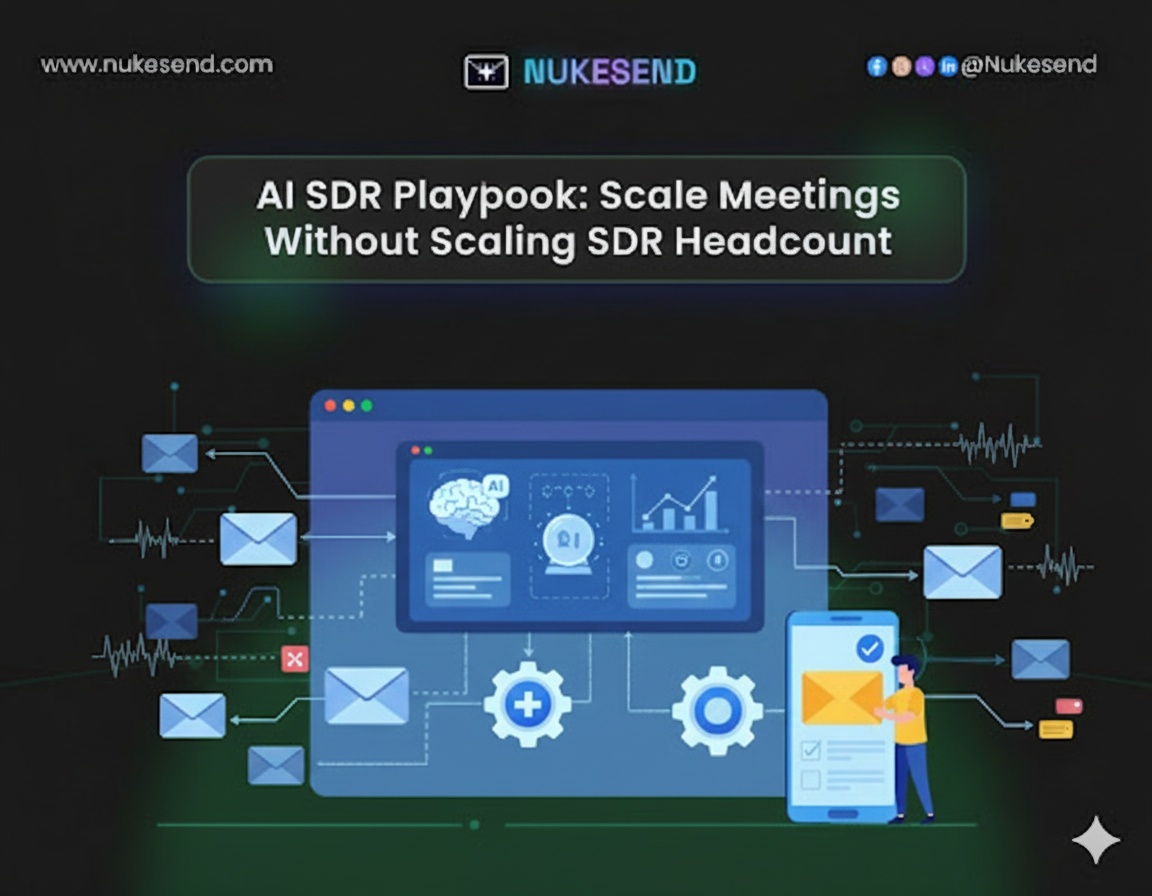
You’ve probably reached this familiar crossroads: your B2B sales pipeline is growing, but your SDR team is already stretched thin. Adding more reps doesn’t scale proportionally — costs rise, ramp times drag, and productivity plateaus. What if there was a way to scale meetings, not headcount?
Welcome to the AI SDR Playbook — your roadmap to automating prospecting, outreach, and meeting booking using intelligent systems that never sleep. This guide will show you exactly how to use AI to multiply SDR output while keeping your team lean and effective.
TL;DR / Quick Answer
Deploying an AI SDR system automates research, outreach, qualification, and meeting scheduling — helping you book more meetings and grow your pipeline without hiring additional SDRs. The result: faster response times, higher conversion rates, and reduced acquisition costs.
Key Facts (2023–2025)
- Sales teams using AI-powered SDR tools reported a 30% increase in lead conversion rates and 60% faster response times (2025, Salesforce).
- Companies deploying autonomous SDR agents achieved 4× higher conversion rates and up to 70% lower CAC than traditional teams (2025, Landbase).
- At Asana, implementing an AI SDR named “Piper” drove a 22% increase in incremental pipeline and eliminated missed inbound chats (2025, Qualified).
- 65% of B2B organizations plan to automate top-of-funnel SDR activities by 2026 (2024, Gartner).
- The average SDR spends 41% of time on non-revenue tasks like data entry and follow-ups (2023, HubSpot).
Why the Traditional SDR Model Hits a Ceiling
The Human SDR Bottleneck
Traditional SDR teams face natural limitations. One rep can only prospect, personalize, and follow up with a few dozen leads per day. Ramp times, context switching, and manual CRM updates reduce output. You might hire five new SDRs — only to see diminishing returns because workflow efficiency never improved.
The math doesn’t lie: headcount growth isn’t the same as productivity growth.
Cost and Ramp Time Reality
Each new SDR means salary, software licenses, management overhead, and roughly 90–120 days of ramp time. During that period, revenue impact is minimal. Worse, high attrition means you start over often — costing thousands per lost rep.
The Multichannel Expectation Gap
Modern buyers expect fast, personalized, and multi-channel interactions — email, LinkedIn, chat, and even SMS. Maintaining that rhythm manually is nearly impossible. That’s why leading teams integrate AI SDRs: to deliver consistent, on-brand engagement around the clock.
What Competitors Miss
Most “sales automation” guides stop at tool recommendations. What they miss is operational strategy — how to actually orchestrate AI, human collaboration, and metrics into a repeatable system. This playbook closes that gap.
Building Your AI SDR Playbook
Step 1: Define Objectives and Ideal Customer Profile (ICP)
Start by defining what success looks like. Do you want to increase outbound meetings by 30%? Reduce response time under 5 minutes? Your goals dictate your system’s architecture.
Then, refine your ICP:
- Industry, company size, and tech stack
- Pain points and triggers
- Buying stage signals (intent data, website visits, etc.)
AI SDRs are only as smart as the data they learn from. Feed them structured, accurate ICP inputs to ensure qualified output.
Step 2: Choose the Right AI SDR Stack
The best AI SDRs integrate multiple functions:
- Data enrichment – pulls from large B2B databases (Apollo, ZoomInfo)
- Outreach automation – executes personalized sequences via email, LinkedIn, or chat
- Natural language generation (NLG) – crafts contextualized outreach messages
- CRM integration – syncs with HubSpot, Salesforce, or Pipedrive
- Scheduling automation – books meetings directly on reps’ calendars
Examples:
- 11x.ai automates full-cycle SDR tasks using 400M+ contact data and custom messaging loops.
- Landbase offers autonomous AI SDRs that manage both inbound and outbound sequences.
- Qualified’s “Piper” integrates AI chat with Salesforce to convert inbound traffic into booked meetings.
When selecting a platform, compare:
| Evaluation Area | Key Criteria |
|---|---|
| Contact Data | Accuracy, depth, GDPR compliance |
| Personalization | Dynamic templates, message scoring |
| Multichannel | Email, chat, LinkedIn, voice |
| Reporting | Pipeline metrics, conversion dashboards |
| Integration | CRM, calendar, analytics tools |
Step 3: Design the Outreach Flow
Every AI SDR system follows this basic loop: .
- Lead ingestion: Pull target accounts from CRM or external sources.
- Enrichment: AI verifies contact data and updates missing fields.
- Message creation: NLP engine generates personalized emails or InMails.
- Outreach sequence: System executes timed, multichannel steps.
- Qualification: Responses are categorized by AI for relevance and intent.
- Scheduling: Calendly-style integration books demos automatically.
- CRM update: Results are logged instantly, keeping records accurate.
This flow ensures continuous prospecting without human bottlenecks.
Step 4: Human + AI Collaboration Model
AI SDRs don’t replace people — they enhance them. Let your AI handle repetitive outreach and qualification while human SDRs manage strategic follow-ups or complex accounts.
At Asana, for example, their AI SDR “Piper” managed inbound conversations 24/7, routing high-intent leads directly to human reps. The result: zero missed leads, a 22% pipeline boost, and faster response times.
Step 5: Measure What Matters
Instead of tracking only activities (emails sent, calls made), monitor outcomes:
- Meetings booked per 100 contacts
- Lead-to-opportunity conversion rate
- Pipeline value per SDR headcount
- Average response time
- CAC reduction percentage
AI systems improve exponentially through feedback loops. Track, analyze, and retrain models every 30–60 days.
Step 6: Scale Intelligently
Once your AI SDR pilot achieves consistent results, scale gradually:
- Expand to new verticals
- Increase outreach volume
- Add personalization layers for regions or roles
Because AI automates outreach, you can grow 3× output with the same team size.
Common Pitfalls & Fixes
Even top-performing teams stumble when implementing AI SDRs. Here’s what to watch for:
- Unclear ICP: Targeting everyone dilutes messaging.
Fix: Define and narrow ICP before sequencing.
- Automation without purpose: Running AI sequences with no benchmarks causes chaos.
Fix: Set specific KPIs like “X meetings per Y prospects.”
- Generic outreach: Copy-paste templates reduce trust.
Fix: Train AI on persona-based variables (industry, role, pain).
- Weak handoff between AI and human SDRs: Leads fall through gaps.
Fix: Create CRM triggers and ownership rules for follow-up.
- Ignoring pipeline metrics: Teams measure emails, not revenue.
Fix: Align dashboards around pipeline contribution and ROI.
- Premature scaling: Expanding before optimizing burns reputation.
Fix: Pilot small, learn fast, scale sustainably.
Implementing these fixes early keeps your AI SDR program efficient and credible.
Real-World Case Examples
Asana Achieves 22% Pipeline Growth with AI SDR “Piper”
Asana faced a common SaaS challenge — inbound leads were dropping off after hours when human SDRs were offline. To bridge the gap, Asana deployed “Piper,” an AI SDR built on conversational AI and real-time visitor engagement technology. Piper engaged leads 24/7, qualifying prospects through CRM-integrated workflows and routing hot leads directly to the right rep.
Results: Asana achieved a 22% increase in total pipeline, reduced missed chat rates to zero, and shortened qualification cycles by nearly 30% (Qualified, 2025). This use of AI-driven sales enablement highlights how intelligent automation boosts responsiveness without adding SDR headcount.
Telecom Company Adds $400K in Monthly Recurring Revenue via Landbase
A North American telecom provider’s outbound SDR team was overwhelmed by a surge in lead volume, slowing response times and follow-ups. The company integrated Landbase AI SDRs to automate multichannel outreach across email, chat, and LinkedIn, using dynamic personalization based on CRM and intent data.
Results: Within one quarter, the team reported 4× higher conversion rates, a 70% reduction in CAC, and $400K in new MRR (Landbase, 2025). This demonstrates the scalability of AI SDR automation for high-volume B2B lead generation while maintaining message relevance and timing.
SaaS Startup Triples Meetings Using 11x.ai
A growth-stage SaaS startup needed to hit aggressive revenue targets without increasing SDR headcount. They adopted 11x.ai, which offered AI SDRs capable of personalizing outreach to over 400 million verified contacts.
Results: The startup tripled its meetings booked and reduced manual prospecting time by 80%, freeing the team to focus on closing deals (11x.ai, 2025). This illustrates how AI-powered SDR outreach can transform early-stage startup growth through automation and precision targeting.
Mid-Market B2B Team Perfects the Human + AI SDR Hybrid Model
A mid-market B2B tech firm wanted to embrace automation but worried about losing personalization. Their solution was a hybrid AI SDR workflow: AI handled enrichment, lead scoring, and follow-ups, while human SDRs managed high-intent conversations. Results: The approach delivered 25% faster response times, higher open and reply rates, and a balanced human-AI collaboration model that preserved authentic engagement while scaling output.
These case studies underscore how AI SDR playbooks enable measurable business growth — from pipeline acceleration and CAC reduction to higher SDR efficiency — across diverse industries and company sizes.
Methodology
Tools Used
- AI SDR vendor reports (11x.ai, Landbase, Qualified)
- CRM data insights (Salesforce, HubSpot)
- Industry research (Gartner, McKinsey, HubSpot)
Data Sources
- Verified 2023–2025 vendor case studies
- Industry-wide sales automation benchmarks
- AI sales performance data from SaaS and enterprise studies
Data Collection & Verification
- Extracted measurable outcomes (pipeline growth, conversion uplift)
- Cross-referenced vendor claims against independent benchmarks
- Prioritized case studies with verifiable metrics
Limitations
- Some data is vendor-supplied (subject to optimism bias)
- Results vary by market, ICP accuracy, and integration depth
- Few independent long-term studies exist yet
This playbook synthesizes the most credible and current available data to guide actionable implementation.
Actionable Conclusion
Scaling meetings without scaling SDR headcount isn’t about replacing humans — it’s about removing their bottlenecks. By integrating AI SDRs into your sales stack, you can automate top-of-funnel workflows, accelerate qualification, and let your team focus on high-value interactions.
Start with a pilot. Track conversion metrics. Optimize sequences. Within months, you’ll see measurable gains — more booked meetings, lower CAC, and happier reps.
References
- 11x.ai. “Top AI SDR Tools in 2025 for Outbound Sales Success.” 2025.
- Landbase. “Top AI SDR Platforms with Strong Inbound Pipeline Generation (2025).” 2025.
- Qualified. “How Asana Scaled Pipeline with Piper the AI SDR Agent.” 2025.
- Jeeva.ai. “AI-Driven Lead Generation Machine: Autonomous SDR Agent Playbook.” 2025.
FAQs
Transform Email Marketing with AI
Boost engagement, revenue, and personalization with smarter AI-driven campaigns in 2025.