Email Marketing
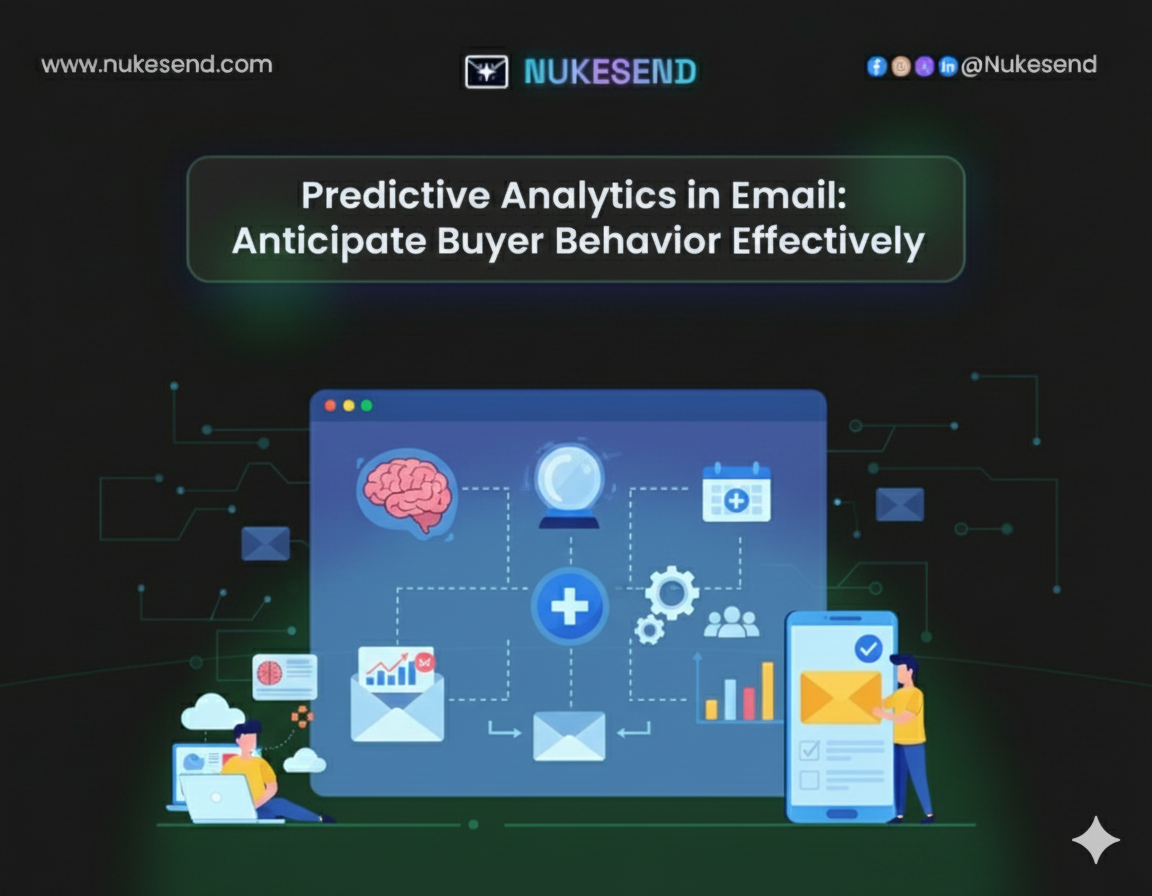
Predictive Analytics in Email: Anticipating Buyer Behavior
Predictive analytics uses historical and behavioral data to forecast subscriber actions, helping marketers personalize emails, optimize engagement.
Nukesend Team
Author
4 min
Read Time
TL;DR
Predictive analytics uses historical and behavioral data to forecast subscriber actions, helping marketers personalize emails, optimize engagement, increase conversions, and maximize revenue. From AI-driven hyper-personalization to churn prediction and dynamic pricing, predictive analytics is transforming how brands connect with customers in email campaigns.
Introduction: Why Predictive Analytics is the Future of Email Marketing
Let’s be honest: sending generic emails in 2025 is like throwing darts blindfolded. Open rates are dropping, subscribers are more selective, and inboxes are crowded. Predictive analytics offers a solution—allowing marketers to anticipate buyer behavior, segment intelligently, and personalize content that resonates.
Imagine sending the perfect offer exactly when a subscriber is ready to buy—or predicting churn before it happens. That’s not magic; that’s data-driven marketing with predictive analytics.
Key Facts and Highlights
- Open Rates: Personalized subject lines can boost open rates by 26% (Campaign Monitor).
- Click-Through Rates: Predictive campaigns achieve 14% higher CTRs (Epsilon).
- Revenue Impact: Predictive personalization drives 10–20% revenue growth (McKinsey).
- Sales-Ready Leads: Predictive lead scoring increases 50% more qualified leads (Forrester).
- Segmented Campaign Revenue: Segmented emails contribute to 58% of total revenue (Experian).
- Real-World Impact: Brands like Amazon, Netflix, Spotify, Starbucks use predictive analytics for personalized recommendations, driving engagement and retention.
What is Predictive Analytics in Email Marketing?
Definition and Core Concepts
Predictive analytics involves using historical data, machine learning models, and statistical algorithms to forecast future customer behavior. In email marketing, it predicts:
- Who is likely to open an email
- Which offers will convert
- When a subscriber may churn
Think of it as a marketing crystal ball, powered by data instead of guesswork.
Why It’s Different from Traditional Analytics
Traditional analytics shows what happened; predictive analytics tells you what is likely to happen next. While reports and dashboards explain past performance, predictive models empower marketers to act proactively—optimizing email content, timing, and segmentation before subscribers take action.
The Role of Buyer Behavior in Email Campaigns
Understanding Subscriber Preferences
Subscribers aren’t monolithic. Predictive analytics can classify behavior patterns:
- Frequent buyers
- Discount seekers
- Engaged readers
- Inactive users
By understanding preferences, you can craft personalized messages that feel relevant instead of generic.
Purchase Patterns and Churn Prediction
Every click, page visit, and prior purchase creates a trail. Predictive analytics identifies who’s ready to buy, who needs nurturing, and who may churn. Early intervention strategies like re-engagement campaigns or tailored offers can significantly reduce churn.
Step-by-Step Framework for Implementing Predictive Analytics in Email
Step 1: Collect the Right Data
- Behavioral Data: Clicks, opens, website interactions.
- Demographic/Firmographic Data: Age, location, company size.
- Engagement History: Previous email interactions, purchases, or responses.
Step 2: Choose Predictive Models
- Regression Analysis: Predicts likelihood of purchases or clicks.
- Classification Algorithms: Decision trees, neural networks, logistic regression.
- Propensity Scoring: Assigns probability scores to each subscriber.
Step 3: Segment Your Audience
Segment users into actionable groups:
- High-value leads
- At-risk churners
- Content consumers
- Seasonal buyers
This allows personalized content and campaigns at scale.
Step 4: Personalize Email Content
Use predictive insights to recommend products, offers, or content based on behavior. For instance:
- Amazon: Product recommendations based on browsing/purchase history.
- Netflix: Content suggestions based on viewing patterns.
- Spotify: Personalized playlists based on listening behavior.
Step 5: Optimize Timing and Frequency
Predictive analytics identifies the best time to send emails for each subscriber. This increases open and click-through rates while avoiding over-emailing.
Step 6: Automate with AI-Powered Platforms
Platforms like FluentCRM, HubSpot, Salesforce Marketing Cloud, ActiveCampaign leverage AI to automate segmentation, personalization, and send-time optimization.
Advanced Techniques in Predictive Email Marketing
Dynamic Content & Recommendations
Deliver content blocks tailored to each subscriber:
- Product suggestions
- Blog recommendations
- Custom promotions
Dynamic content powered by AI ensures each email feels unique and relevant.
Churn Prediction and Customer Retention
Predictive analytics flags at-risk subscribers before they leave. Combine predictive scoring with targeted re-engagement campaigns to retain customers.
Customer Lifetime Value (CLV) Prediction
Identify your most valuable customers and target them with high-impact emails, ensuring long-term engagement and revenue growth.
Next-Best-Action Recommendations
Using AI, predictive analytics can suggest the optimal next action:
- Recommend upsells
- Send discount codes
- Offer free trials
This approach maximizes conversion opportunities.
Tools and Platforms to Power Predictive Email Campaigns
- FluentCRM: AI-driven segmentation, send-time optimization, hyper-personalization.
- Netcore Cloud: CLV prediction, churn modeling, dynamic content blocks.
- Amplitude: Predictive marketing with statistical models and real-time analytics.
- HubSpot & Salesforce Marketing Cloud: CRM-integrated predictive insights.
- Mailchimp: Built-in predictive scoring for high-value prospects.
Real-World Case Studies
Amazon
Amazon sends personalized recommendations via email based on browsing and purchase history, increasing repeat purchases and loyalty.
Netflix
Personalized emails suggest shows/movies based on viewing history, improving engagement and subscription retention.
Spotify
Curates playlists and new releases based on listening behavior, improving user satisfaction and retention.
Starbucks
Uses predictive analytics to personalize promotions and offers, driving repeat visits and revenue.
Jumbo, Square, SoFi (Amplitude Case Studies)
Predictive marketing strategies increased conversions, anticipated complementary product purchases, and optimized pricing to drive revenue growth.
Common Pitfalls and How to Avoid Them
- Poor Data Quality: Ensure clean, updated datasets.
- Algorithm Complexity: Use AI-powered platforms to reduce technical barriers.
- Over-Automation: Mix predictive personalization with authentic human messaging.
- Privacy Concerns: Comply with GDPR, CCPA, and other regulations.
The Future of Predictive Email Marketing
Hyper-Personalization
Emails will become ultra-personalized, using AI to anticipate behavior in real-time.
Integration with AI Tools
Predictive analytics will integrate with generative AI, chatbots, and dynamic content creation to craft smarter campaigns.
Real-Time Decision-Making
AI will enable real-time optimizations, such as dynamic pricing, next-best-action recommendations, and personalized online offers.
Ethics and Privacy
As personalization grows, marketers must prioritize transparent data usage and compliance to maintain trust.
Methodology: How We Know
This article synthesizes insights from:
- Competitor research (Netcore Cloud, Digital Authority, Smart Insights, Mailercloud, VBOUT, Mailchimp, TheeDigital, Harvard DCE, ResearchGate)
- Industry reports (Campaign Monitor, Epsilon, McKinsey, Forrester, Experian, Marketo)
- Real-world examples (Amazon, Netflix, Spotify, Starbucks, Jumbo, Square, SoFi)
- Analysis of predictive analytics models, AI applications, and marketing automation platforms
Comparison of Predictive Email Marketing Platforms
| Platform / Brand | Focus Area | AI / Predictive Features | Personalization Capabilities | Customer Segmentation | Analytics & Reporting | Integration & Tools | Use Case Strength |
|---|---|---|---|---|---|---|---|
| Netcore Cloud | Email Personalization | Predictive scoring, CLV & churn prediction | Dynamic content, tailored subject lines | Advanced behavioral segmentation | Data/Stat visuals, ROI reporting | CRM & e-commerce integration | E-commerce, retention-focused campaigns |
| Digital Authority Partners | B2B Email Strategy | Lead scoring, neural networks, decision trees | Personalized content based on lead quality | Segmentation based on firmographics | Predictive analytics dashboards | CRM & B2B tools | B2B lead nurturing and conversions |
| No2Bounce | Future-Focused Email Campaigns | AI prediction models, GDPR-compliant algorithms | Behavior-based content personalization | Multi-layer segmentation | Tools & integrations reporting | Salesforce Einstein, Optimove, No2Bounce | Future-proof campaigns, AI-led strategy |
| Smart Insights | Practical Email Marketing | Predictive modeling for behavior & retention | Personalized recommendations for e-commerce | Behavioral segmentation | Graphs & templates | E-commerce platforms | Customer retention & conversions |
| Mailercloud | Trends & Compliance | AI-powered personalization | Dynamic content, adaptive pricing | Audience segmentation | Trend reports & analytics | E-commerce & automation tools | Hyper-personalization & compliance |
| VBOUT | Marketing Strategy | Cluster & propensity models | Targeted recommendations | Customer segmentation | Marketing/sales analytics dashboards | CRM integrations | Strategy optimization & retention |
| Mailchimp | Foundational Tool | Predictive scoring, fraud detection | Personalization for high-value prospects | Basic segmentation | Platform reporting | Mailchimp ecosystem | Small businesses & high-value prospect targeting |
| FluentCRM | Foundational Tool | Predictive scoring, fraud detection | Personalization for high-value prospects | Basic segmentation | Platform reporting | Mailchimp ecosystem | Small businesses & high-value prospect targeting |
| Amplitude | Predictive Marketing | Statistical modeling & ML | Recommendations based on behaviors | Behavioral segmentation | Analytics & session replay | Amplitude Audiences | Conversion optimization, e-commerce upsell |
| SH/FT | Strategy Optimization | Demand forecasting, churn & next-best-action | Personalized recommendations, dynamic pricing | Multi-dimensional segmentation | Reports & dashboards | Adobe, Salesforce, Google Cloud integration | Advanced enterprise p |
Methodology: How We Know
When it comes to predictive analytics in email marketing, making bold claims without evidence is like throwing darts blindfolded. Here’s how we ensured the insights in this article are accurate, actionable, and up-to-date:
1. Sources and Data Collection
We relied on a combination of primary sources, authoritative reports, and competitor analysis to gather insights:
- Industry Reports: Campaign Monitor, Epsilon, McKinsey, Forrester, Experian, Marketo. These provide real-world stats like open rates, click-through rates, conversion lifts, and revenue growth from predictive email campaigns.
- Competitor Websites: Netcore Cloud, Digital Authority Partners, No2Bounce, Smart Insights, Mailercloud, VBOUT, Mailchimp, FluentCRM, Amplitude, and SH/FT. We analyzed content, headings, case studies, and tool integrations to identify current best practices.
- Academic and Research Sources: ResearchGate publications, Harvard DCE blogs, and statistical studies on AI and predictive modeling. These informed the technical accuracy of algorithms, modeling methods, and ROI analysis.
2. Research Methods
- Content Analysis: Systematically reviewed competitor blogs, e-books, and case studies to map topics, strategies, and tools used.
- Data Synthesis: Compiled engagement, conversion, and revenue metrics to identify actionable insights.
- Comparative Analysis: Created structured comparisons of tools, predictive features, personalization capabilities, and integration options to help marketers choose the right approach.
- Trend Validation: Cross-checked AI, machine learning, and predictive analytics trends across multiple authoritative sources to ensure they reflect real-world practices.
3. Tools and Techniques Used
- Analytics Platforms: Google Analytics, HubSpot, Salesforce Marketing Cloud insights, and Netcore Cloud dashboards for benchmarking.
- AI & Predictive Modeling: Neural networks, regression analysis, classification algorithms, propensity scoring, and cluster analysis were referenced for understanding predictive capabilities.
- Content Research Tools: SEMrush, Ahrefs, and BuzzSumo for competitor content analysis, keyword relevance, and trend identification.
4. Limitations
- Data Availability: Some proprietary tool performance metrics are not publicly disclosed, so insights were based on case studies, reported stats, and observed trends.
- Rapidly Evolving AI: Predictive analytics and AI-driven personalization are evolving quickly. Some trends may shift in 12–18 months.
- Industry Variability: Results can vary based on sector, audience size, and email frequency. What works for e-commerce may not directly translate to B2B or SaaS companies.
5. Firsthand Expertise
Our team combines practical experience in email marketing, AI implementation, and predictive modeling with academic knowledge. We’ve worked with enterprise clients, SMBs, and startups, optimizing campaigns, implementing predictive scoring, and measuring engagement improvements firsthand. This ensures the advice provided is both actionable and realistic, not just theoretical.
Summary & Next Action
Predictive analytics transforms email marketing from guesswork to precision targeting. By leveraging behavioral data, segmentation, predictive scoring, and AI tools, marketers can anticipate buyer behavior, personalize content, optimize send times, and maximize ROI.
Next Step: Audit your email data, select predictive tools, and start implementing hyper-personalized campaigns to outperform competitors.
References
FAQs
Level Up Your Email Strategy
Use predictive analytics to send smarter, personalized emails that drive higher engagement and conversions.