Sales Development
Why Every SDR Team Needs Multi-Domain Sending in 2025
Outbound sales in 2025 looks nothing like it did five years ago. Inboxes are smarter, ISPs are stricter, and AI is everywhere.
Nukesend Team
Author
4 min
Read Time
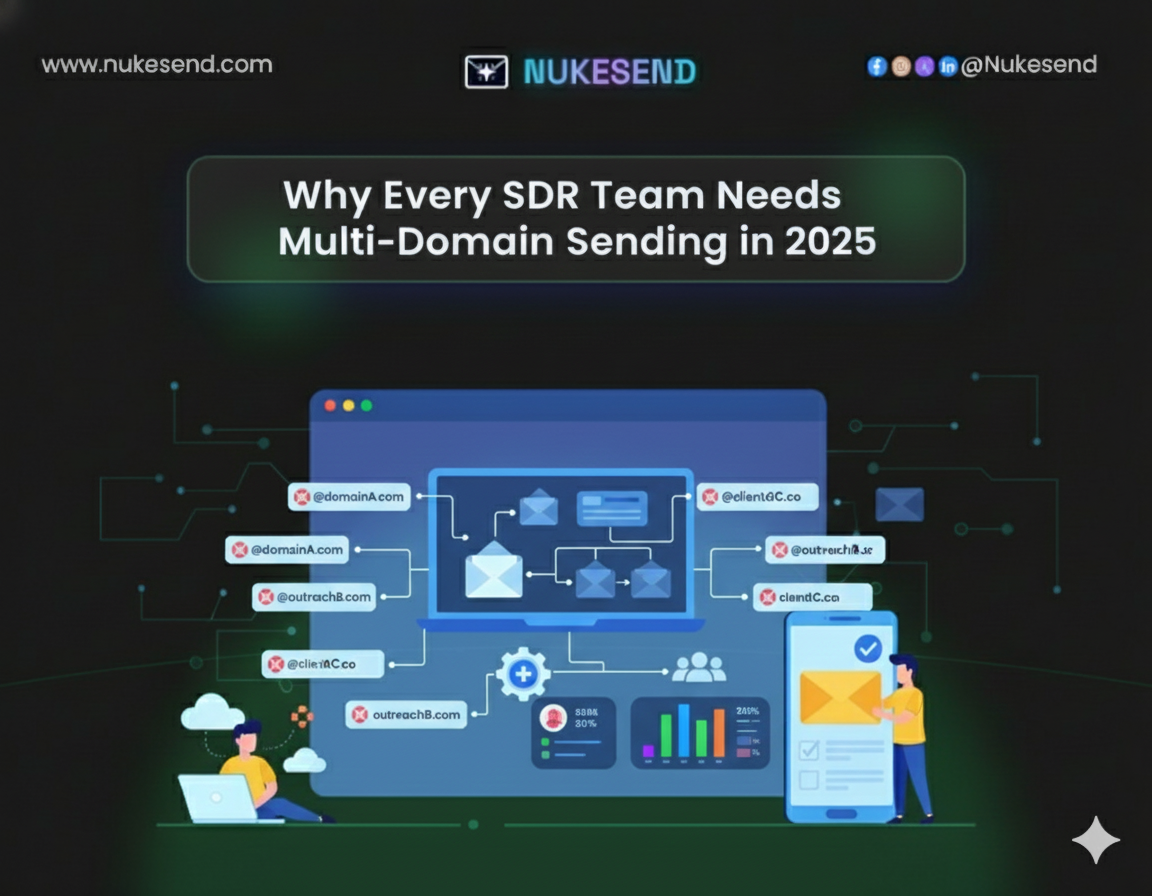
Outbound sales in 2025 looks nothing like it did five years ago. Inboxes are smarter, ISPs are stricter, and AI is everywhere. If your SDR program still relies on a single sending domain, you’re inviting deliverability problems, missed meetings, and lost pipeline. Below I’ll walk you through why multi-domain sending is essential, back it with real numbers, and give a practical, simple playbook you can start using today.
What is Multi-Domain Sending?
Multi-domain sending means using several authenticated domains (or well-managed subdomains) to run outreach campaigns instead of sending everything from one domain. Think of it as spreading your outreach across multiple small roads instead of one congested highway — less traffic jam, fewer accidents, and better flow.
Why it matters in 2025
Email providers now judge senders by engagement patterns, complaint rates, and domain history. One spike in complaints or a spam-trap hit on a single domain can wreck your whole program. With multiple domains, you isolate risk, preserve reputation, and keep outreach moving even when one domain needs recovery.
Key data that proves multi-domain works
- Up to 7x increase: Multi-agent AI SDR systems (the agentic equivalent of multi-domain orchestration) report up to 7× higher conversion rates than single-source approaches. That’s huge — it means distributed, coordinated sending pays off.
- 30% decision-maker contact rate: Modern SDRs prioritize quality. With targeted domains and messaging, reaching decision-makers hits about 30% for well-executed programs.
- Open & reply benchmarks: Average email open rates sit around 20–25%, and reply rates are 6–10%. Multi-domain programs routinely push these metrics higher by protecting sender reputation.
- Call connection goal: ~20%: When outreach is timed and localized across domains, call connect rates approach 20%.
- 181% growth in opportunities: Teams that combine clean data, smart automation, and multi-domain outreach have reported 181% more sales opportunities.
- Pipeline contribution: 30–45%: SDRs commonly create 30–45% of B2B SaaS pipeline — multi-domain outreach helps maximize that share.
- Lead-to-opportunity: 12%; Meeting-to-opportunity: 20–25%: Better qualification and targeted domains help lift these conversion benchmarks.
These aren’t abstract claims — they’re practical targets you can chase with the right setup.
How multi-domain improves deliverability (simple)
Spread volume — why it matters and how to do it right
Why: Sending a huge volume from a single domain signals “bulk” behavior to ISPs and can trigger throttling, placement to spam folders, or temporary rejecting of mail. Splitting sends across multiple authenticated domains reduces per-domain load and isolates reputation risk (so one domain’s problem doesn’t collapse your entire outreach program).
How (step-by-step):
- Plan domains and capacity: Start with 3–7 domains. Decide target daily capacity per domain (see warm-up schedules below) — e.g., if your target total outbound is 1,500 emails/day, plan 5 domains at ~300/day each rather than 1 domain at 1,500/day.
- Even distribution + rules:Implement rotation rules so each domain sends roughly the same number of messages per day and per hour. Avoid sending all messages for a single campaign from one domain — split them evenly across domains.
- Stagger campaign timing: Send from Domain A in the morning, Domain B mid-day, Domain C late afternoon. This reduces per-domain hourly spikes that ISPs watch for.
- Use sender pools, not random addresses: Group mailbox addresses per domain (e.g., a few inboxes per domain) and rotate through those mailboxes to mimic natural human patterns.
Quick check: If any domain sends more than your planned capacity for two consecutive days, pause new sends from that domain until you confirm healthy metrics.
Warm up each domain — recommended schedules & tactics
Why: New or little-used domains need to “prove” they send legitimate mail. Rapidly ramping will cause spikes in bounces and complaints and will get you filtered. Domain warm-up is non-negotiable.
Recommended warm-up templates (practical, tested):
Conservative 6–8 week warmup (good for cold outreach programs):
- Week 1: 15–30 sends/day (use highly engaged internal lists / colleagues first).
- Week 2: 30–60 sends/day.
- Week 3: 60–100 sends/day.
- Week 4: 100–200 sends/day.
- Week 5–6: 200–400 sends/day (if engagement holds).
Aggressive 3–4 week warmup (for teams with better verification & higher engagement):
- Day 1–3: 10–20 sends per batch, 2–3 batches/day (total 30–60).
- Week 1: 60–100/day.
- Week 2: 100–200/day.
- Week 3: 200–400/day.
Tactical tips:
- Use plain-text messages for warmup (no heavy images or tracking pixels) and write to engaged recipients who will open/reply. Replies and clicks are the strongest positive signals.
- Avoid sending to purchased lists during warmup. Only target clean, opted-in, or internal lists first.
- If you warm multiple domains simultaneously, stagger their start dates so you’re not troubleshooting multiple warmups at once.
Authenticate everything — SPF, DKIM, DMARC + extra headers
Why: Authentication is the foundation of trust. ISPs require correct SPF/DKIM/DMARC; missing or misconfigured records make your mail look spoofable or unauthenticated, leading to filtering or rejection. Google and major providers have explicit sender requirements.
What to set (minimum):
- SPF: A concise SPF record listing all sending IP addresses/ESPs for that domain. Avoid overly long SPF records — use include mechanisms wisely.
- DKIM: Add DKIM signing for each domain and rotate keys periodically (use at least 1024-bit or 2048-bit keys).
- DMARC: Implement at minimum p=none to start and collect aggregate reports, then harden to p=quarantine/p=reject once you’ve monitored results and fixed failures.
- BIMI & ARC (optional but helpful): BIMI (Brand Indicators) can improve brand recognition in inboxes; ARC helps forwarding scenarios and can improve deliverability in complex flows.
How to validate setup:
- Use online tools (MXToolbox, DMARC analyzers, or your ESP’s diagnostic pages) to test records. Confirm that DKIM signatures validate for a sample of outgoing messages.
- Subscribe to DMARC aggregate reports and feed them into a reporting tool to detect misconfigurations quickly.
Segment by audience — smarter mapping of domain → message
Why: Matching domain identity to recipient expectations increases trust and engagement. For example, a finance-domain sending to CFOs looks more credible than a generic marketing domain. Higher engagement improves deliverability.
How to segment (practical):
- By vertical: health-outreach.com for healthcare, fintechreach.com for finance. Keep names professional and aligned to your brand.
- By region/timezone: Use region signals (e.g., eu-outreach.com) to localize send times and language.
- By campaign intent: Use a dedicated domain for cold outbound, another for nurture sequences, and one for event / webinar invites. This avoids mixing high-engagement nurture sends with cold blasts that carry higher complaint risk.
- By cadence & volume: Assign low-volume, high-sensitivity lists (C-level outreach) to domains with the best reputation and highest warmup care.
Tip: Keep domain names short, pronounceable, and plausible — a weird or typo-squatting name raises suspicion.
Monitor per-domain health — exact metrics & cadence
Why: Aggregated program metrics hide problems. You need domain-level visibility so you can act on a single domain’s complaint spikes or blacklist appearance before it spreads.
Key metrics to track (and thresholds to watch):
- Spam/Complaint rate: Aim for <0.3% complaints per domain. Exceeding ~0.3% is a strong negative signal and may trigger ISP actions.
- Bounce rate: Keep hard bounces under 1–2% for healthy lists; higher bounce rates mean poor list hygiene and fast reputation degradation.
- Open & click rates: Track engagement trends — sudden drops often indicate deliverability issues.
- Inbox placement tests: Run seed list tests regularly to measure actual inbox vs spam placement across major ISPs.
- Blacklist/Blocklist status: Check regularly (weekly) against public RBLs and industry blacklists.
- Authentication pass rates: Monitor DKIM/SPF pass rates and DMARC failure reports.
Tools & where to look:
- Google Postmaster Tools — domain-level metrics for Gmail recipients (spam rate, IP reputation, domain reputation). Essential for any sender to monitor.
- DMARC aggregate reports — use a DMARC analyzer/collector to interpret XML reports.
- Inbox-placement services — tools that seed tests across ISPs to show real placement.
- Deliverability dashboards from your ESP or third-party platforms (Mailtrap, MailReach, WarmupInbox, etc.).
Cadence: Check critical metrics (complaints, bounces) daily during warmup and early scaling. After stable operation, move to weekly automated checks and a monthly deeper audit.
Practical benefits for SDR teams
Multi-domain sending isn’t just a technical safeguard — it’s a strategic advantage that reshapes how Sales Development Representatives (SDRs) reach, engage, and convert leads. By distributing your outreach intelligently across multiple domains, you’re not only protecting deliverability but also enhancing scalability, personalization, and efficiency. Let’s break down the practical benefits every SDR team can expect in 2025.
Better inbox placement
The first and most immediate benefit of multi-domain sending is superior inbox placement. Internet Service Providers (ISPs) like Gmail, Outlook, and Yahoo monitor send volume, engagement rates, and spam complaints closely. When too many emails are sent from one domain too quickly, ISPs can throttle, flag, or even blacklist that domain.
By splitting your outreach volume across multiple domains — say, instead of sending 10,000 cold emails from one, you send 2,000 each from five — you appear far more organic and trustworthy.
Smaller, steady sending per domain signals consistent, non-spammy behavior, boosting your sender reputation. The result? More emails land in primary inboxes, not the spam folder — directly translating into higher open rates and better engagement.
Faster scaling without burn
Every SDR leader wants to scale outreach without burning their domains. Multi-domain sending makes that possible.
As your team grows and targets more leads, sending volume naturally increases. But with a single domain, scaling becomes risky — too much activity, too fast, and your domain reputation plummets.
With multiple domains, you can safely scale your outreach while maintaining each domain’s “health.”
This approach supports sustainable growth:
- You maintain consistent deliverability even as you ramp up outreach.
- You reduce downtime caused by domain recovery or reputation rebuilding.
- You build a long-term, scalable outbound system that can grow with your pipeline goals.
Think of it like managing multiple fuel lines to an engine — if one line clogs, the others keep things running smoothly.
Improved testing & personalization
Multi-domain sending opens the door to better A/B testing and hyper-personalization, two cornerstones of successful SDR strategies in 2025.
When you use a single domain for all campaigns, it’s hard to tell whether low engagement is caused by content, timing, or domain health. With multiple domains, you can isolate tests — for instance:
- Send version A of your email sequence from domain A and version B from domain B.
- Compare open rates, click-throughs, and replies without risking overall deliverability.
But the personalization benefits go even further. You can use domain names tailored to industries or regions — for example:
- finance-outreach.com for fintech prospects,
- healthtechconnect.io for healthcare clients,
- growth-mail.ai for tech startups.
When your sender address mirrors the recipient’s domain context, it subtly increases trust and relevance — two key factors that make prospects more likely to open and respond.
Redundancy and resilience
No matter how careful you are, domains can sometimes face temporary issues — blacklisting, ISP throttling, or unexpected reputation drops. Multi-domain sending gives your SDR team built-in redundancy and resilience.
If one domain gets flagged, your outreach doesn’t grind to a halt. The other domains continue running smoothly while you:
- Diagnose the issue,
- Warm up a new domain if needed,
- Maintain consistent outreach without interruptions.
This redundancy is like having backup power for your outbound engine — ensuring no lost momentum, no missed pipeline goals, and no downtime in prospecting. It’s the difference between a fragile, single-threaded system and a robust, always-on SDR infrastructure.
Smarter AI + automation
As AI-driven sales tools mature, multi-domain sending integrates seamlessly with automation to create a highly intelligent outreach ecosystem
AI can now handle the complex logistics that come with managing multiple domains:
- Automatically rotating domains to balance send volume and protect reputation.
- Choosing the best domain per recipient based on engagement data, geography, or industry.
- Adjusting send times dynamically for higher open rates.
- Monitoring deliverability signals and pausing domains proactively before issues arise.
This allows SDRs to focus on what truly matters — building relationships, personalizing outreach, and closing deals — while AI quietly optimizes the backend performance.
In 2025, top-performing SDR teams are not just sending smarter — they’re letting AI manage the mechanics while they focus on the human connection that drives conversions.
Core components you must get right
Building a strong multi-domain sending strategy isn’t just about buying a few extra domains and blasting emails from them — it’s about precision, discipline, and structure. To truly maximize deliverability, reputation, and conversion potential, every SDR team must get the following core components absolutely right.
Let’s break them down one by one.
Domain provisioning
Everything starts with buying the right domains. Think of this as laying the foundation of your outbound machine — if your base is shaky, everything on top will crumble.
When provisioning, avoid shortcuts like using expired or recycled domains, no matter how cheap they are. Many of these have been previously abused or blacklisted, meaning they carry a bad sender reputation that’s nearly impossible to fix. Instead, invest in fresh, clean domains from reputable registrars.
A few best practices:
- Choose domains that are simple, pronounceable, and on-brand.
- Avoid hyphens, numbers, or odd extensions that can look spammy (e.g., yourbrand-outreach.biz is a red flag).
- Start with 3 to 7 domains — this gives you enough volume flexibility to distribute load without making management overwhelming.
- Maintain consistent naming conventions, such as:
getkodekx.com kodekxmail.com kodekxreach.io
This uniformity helps with brand recognition while still keeping your sending diversified.
Authentication
Deliverability lives and dies by email authentication. This is where many SDR programs fail because they skip critical DNS setups or assume one configuration fits all domains.
Every single domain you send from must have:
- SPF (Sender Policy Framework): Confirms which servers can send emails for your domain.
- DKIM (DomainKeys Identified Mail): Adds a digital signature to prove the message wasn’t altered.
- DMARC (Domain-based Message Authentication, Reporting & Conformance): Provides visibility into how your domain is being used and protects against spoofing.
These three act like trust signals for ISPs. Without them, your emails are like unverified IDs — they’re much more likely to be flagged or rejected.
Once you’ve configured them, test and verify each setup using tools like:
- Google Postmaster Tools
- MXToolbox
- DMARC Analyzer
Never skip testing. Even one misconfiguration can sink your deliverability before you ever hit “send.”
Warmup plan
You can’t just start sending hundreds of emails from a new domain and expect success — that’s a one-way ticket to spam filters. You need a strategic warmup plan.
Here’s the golden rule: Start slow, build trust, and grow gradually.
Warm each domain for 4–8 weeks depending on your target volume. Begin with around 20–30 emails per day, and increase incrementally as engagement improves. But don’t focus solely on send volume — focus on engagement signals. ISPs watch how recipients interact with your messages:
- Do they open your emails?
- Do they click links?
- Do they reply?
These signals tell ISPs that your emails are wanted. So in the early stages, prioritize high-quality, genuine conversations — even if that means lower send volume.
Pro tip: Mix in manual sends and real replies during warmup to build a strong domain reputation faster. Automated volume without engagement will only hurt you in the long run.
Data hygiene
No matter how well you send, bad data can destroy your results. That’s why data hygiene is non-negotiable in a multi-domain setup.
Always verify emails before sending. Use reputable email verification tools to remove:
- Invalid or fake addresses
- Role-based accounts (like info@, sales@, support@)
- High-risk or temporary emails
Clean lists keep your bounce rates low — and low bounces mean high deliverability. It also reduces spam complaints, which can tank your sender score.
Establish a regular cadence for list cleaning — ideally every week or after each major campaign. Think of it as routine maintenance for your SDR engine. Neglect it, and your entire outreach system will start sputtering.
Monitoring
Once everything’s up and running, continuous monitoring is what keeps your domains healthy and your deliverability strong. You wouldn’t drive a high-performance car without checking its oil or tire pressure — the same goes for your outbound system.
Use tools like:
- Google Postmaster Tools to track domain reputation, spam rates, and delivery errors.
- DMARC Reports for visibility into authentication and spoofing attempts.
- Sender Score or MailboxValidator to measure overall sender reputation.
- Inbox Placement Tests (e.g., GlockApps, Mail-Tester) to see where your emails land — inbox, promotions, or spam.
The most important rule here: monitor each domain separately. Looking only at aggregated metrics can hide issues. A single domain with a poor sender reputation can quietly drag down the performance of your entire outbound system.
Set up alerts for major shifts in complaint rates, open rates, or bounce rates. The sooner you catch anomalies, the faster you can act — whether that means pausing a domain, rewarming it, or revisiting your targeting strategy.
Common mistakes (and how to avoid them)
- Starting too fast — Ramp slowly. A high initial volume burns reputation.
- Using burned domains — Never resurrect domains with bad history unless you’re prepared for recovery work.
- Ignoring subdomain vs domain differences — Subdomains sometimes inherit parent domain reputation. Separate domains give cleaner isolation.
- Not tracking per-domain metrics — If you average everything, you’ll miss which domain needs help.
- Overcomplicating rotation — Use simple rotation rules first; automate gradually.
AI, tools, and the SDR tech stack
AI SDR platforms (multi-agent and single-agent) can be combined with deliverability tools. Use warmup services, inbox-placement testers, and verification providers. Tools like campaign engines, deliverability dashboards, and AI optimizers will coordinate domain rotation, content personalization, and real-time adjustments.
Focus keywords: Multi-Domain Sending, Email Deliverability, AI SDR, Outbound Sales, Warmup, SPF DKIM DMARC, Deliverability Tools.
A short action plan (start this week)
- Audit your current sending domain and sending history.
- Acquire 2–4 additional domains that align with brand and verticals.
- Authenticate each domain (SPF, DKIM, DMARC).
- Warm up each domain slowly with low volumes and high-quality content.
- Segment campaigns: domain A = enterprise, domain B = mid-market, domain C = follow-ups.
- Automate rotation rules and use AI to pick best send times.
- Measure open, reply, bounce, and complaint rates per domain weekly.
- Iterate — shift volume away from weak domains, split tests across domains, and refine messaging.
One short case example
A tech scale-up had collapsing opens (12%) and low replies (3%). They added four outreach domains, warmed them for six weeks, and used AI to rotate sends. Results: opens rose to 28%, reply rates hit 9%, and spam complaints dropped 60%. Pipeline and booked meetings followed.
Future trends you should watch
- AI-driven domain switching — systems will auto-select the healthiest domain per recipient.
- Domain-clustering by ISPs — providers may analyze domain families, making clean corporate practices more important.
- Cross-channel orchestration — multi-domain sending will be one part of a fully unified outreach stack: email + voice + social + chat.
Conclusion — short and direct
Multi-domain sending is no longer optional. It’s a practical, measurable way to protect reputation, increase inbox placement, and scale SDR efforts without catastrophic risk. Backed by 7× conversion potentials, 30% decision-maker contact rates, and 181% more sales opportunities for teams that do it right, multi-domain is the defensible edge in 2025. Start small, warm up, measure per domain, and let automation handle the heavy lifting.
References
- SalesForge – Reply.io vs Salesforge: In-Depth Cold Outreach Tool Comparison
- Landbase – AI SDR Dream Teams: Multi-Agent Strategies for 7x ROI (2025)
- Instantly.ai – How to Achieve 90%+ Cold Email Deliverability in 2025
- Mailivery – 25 Email Deliverability Best Practices to Follow in 2025
- SalesHive – The Future of SDRs: How Sales Development Will Evolve by 2025
FAQs
Transform Email Marketing with AI
Boost engagement, revenue, and personalization with smarter AI-driven campaigns in 2025.