Business
Why Nukesend Beats Marketing Automation for SDR Productivity
You’re an SDR-leader or a sales development rep, staring at an inbox overflowing with generic outreach and a pipeline that’s slow to move.
Nukesend Team
Author
4 min
Read Time
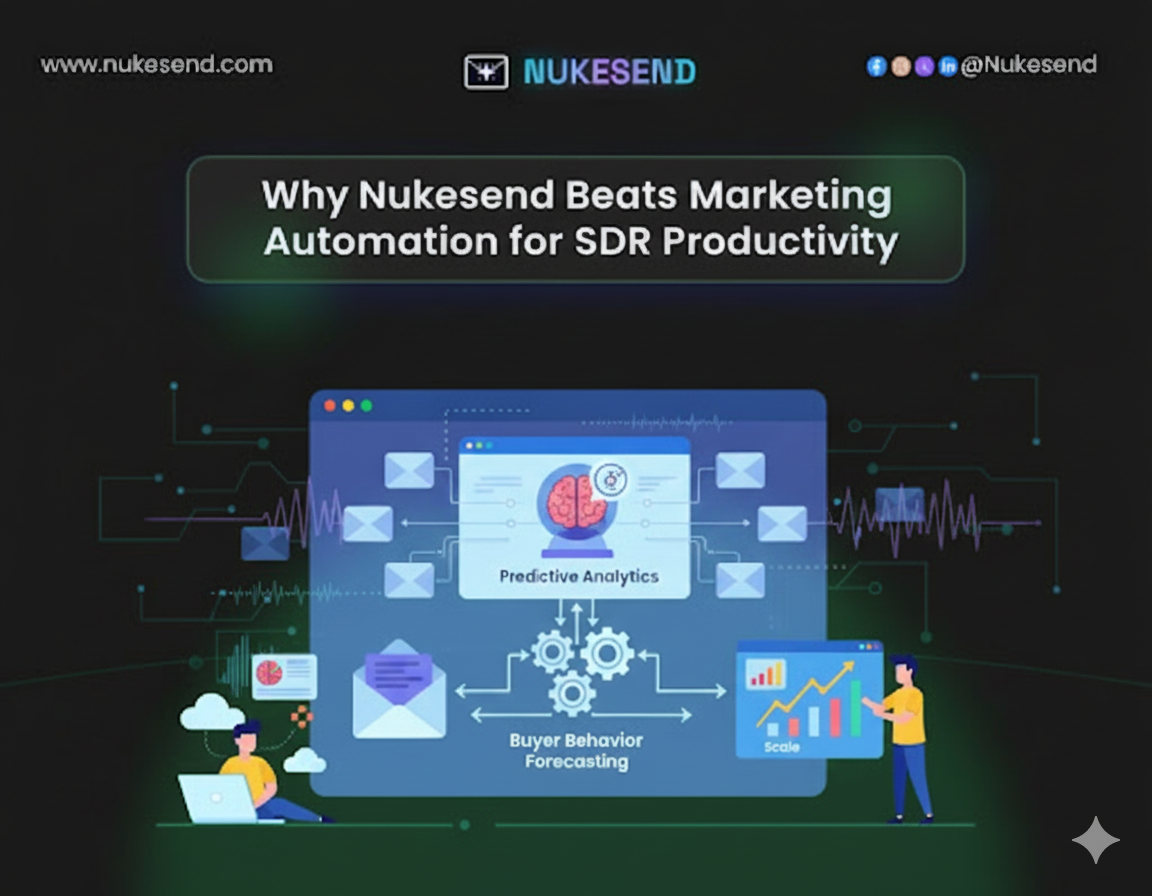
You’re an SDR-leader or a sales development rep, staring at an inbox overflowing with generic outreach and a pipeline that’s slow to move. Your team uses traditional marketing automation tools, but you’re not seeing the lift you expected. What if there was a tool built specifically to amplify SDR productivity—not just automate marketing emails? Enter Nukesend, a specialized behavioral-email automation platform that transforms how SDRs engage prospects, streamline workflows and convert leads. In this article, you’ll discover how Nukesend outpaces legacy marketing automation platforms, what makes it uniquely effective at the SDR level, and how you can deploy it to accelerate outreach, qualification and pipeline velocity.
TL;DR / Quick Answer
Nukesend delivers higher SDR productivity by combining behavioral triggers, role-based personalization, real-time sequencing and CRM integrations—making outreach smarter and faster than generic marketing automation tools.
Key Facts (2023–2025)
- 63% of SaaS users decide whether to stay or leave within the first seven days, highlighting the importance of onboarding and timely outreach (2024, Gartner).
- SDRs using signal-based ABM tools plus AI automation achieved 2× more sales opportunities in a quarter compared to prior benchmarks (2025, Demandbase).
- Over 70% of outbound sales teams are using AI to improve prospecting in 2025 (LeadSend survey, 2025).
- Personalized, role‐based email sequences outperform generic drip campaigns and improve engagement 30–50% (2023, HubSpot).
- Automation that frees SDRs from manual research tasks allows a shift to higher-value interactions and better conversion rates (2025, Nooks.ai).
The Limitations of Traditional Marketing Automation for SDRs
Why “One-size-fits-all” Marketing Automation Falls Short
Many companies rely on marketing automation platforms like Marketo, Pardot or even the automation modules in HubSpot Marketing Hub to manage emails, campaigns and lead nurturing. These tools are powerful for broad-based marketing efforts (top-of-funnel messaging, lead capture, drip campaigns), but they typically don’t address the nuances and pace of SDR workflows. Key limitations include:
- Lack of SDR focus: Marketing automation is designed for volume and consistency, not real-time outreach, prioritization or lead qualification.
- Generic sequences: Drip campaigns send predetermined content without adjusting to changing behavior or prospect nuance.
- Overloaded SDR workflows: SDRs still spend hours in manual research, lead scoring, and follow-up scheduling because the tool isn’t tuned for SDR tasks.
- Weak deliverability personalization: Marketing emails are generic; deliverability and personalization tailored to SDR outreach are less optimized.
- Slow reaction to real-time signals: Most platforms send scheduled emails rather than reacting when a prospect takes a specific action or drops off mid-funnel.
Why SDR Productivity Isn’t Just about More Automation
Automation alone isn’t enough. As noted by Nooks.ai, AI SDR tools improve productivity by enabling SDRs to spend time on meaningful conversations—not just automating tasks. nooks.ai Furthermore, Demandbase found that when SDRs used signal-based tools and AI automation, they doubled their opportunity creation by shifting away from manual research to high-impact outreach. Demandbase So automation must be intelligent, behavioral, and SDR-centric—not a marketer’s drip engine.
How Nukesend Elevates SDR Productivity
Behavioral Triggers & Real-Time Sequencing
Unlike standard marketing automation which follows a fixed schedule (e.g., email every three days), Nukesend uses behavioral triggers—actions like “did not log in within 48 hours,” “added payment method,” “invited teammate but no usage”—to determine what message to send next. For example:
- A user signs up, doesn’t log in: automatically trigger a “Let’s get started” email with quick-start tips.
- A user logs in but doesn’t invite teammates: trigger a “Invite your team, unlock collaboration” message.
- A high-value account shows usage but no upgrade: trigger upsell positioning content.
By responding to behavior rather than time alone, SDRs using Nukesend can engage prospects when they are most receptive, reducing drop-off and wasted outreach.
Role-Based Personalization & AI Sequencing
Nukesend allows segmentation by role, industry, company size, or behavior so that SDR outreach is highly personalized. For example, a product manager at a fintech startup might get a different email than an operations manager at healthcare. Nukesend also uses AI to optimize send times, subject lines and message order for higher open rates and reply likelihood (2023, HubSpot). This level of personalization enhances SDR effectiveness by making each outreach feel relevant, increasing reply rates and meeting bookings.
CRM & Data Integration for End-to-End SDR Workflow
Nukesend integrates with CRMs like HubSpot CRM and Salesforce, payment processors such as Stripe, analytics tools like Mixpanel, enabling SDRs to have a seamless flow: sign-up → behavioral trigger → outreach → qualification → conversion—all tracked and optimized. That integration ensures SDRs aren’t switching tools and losing momentum; instead automation supports high-velocity outreach directly from CRM signals.
Focused for SDRs, not just Marketers
Because Nukesend is built with SDR productivity in mind, it shifts the workflow away from broad marketing automation to SDR-specific tasks: faster qualification, smarter outreach, fewer manual touches, scalable sequences, high personalization, and real-time reaction. This focus addresses the major gaps that generic marketing automation platforms leave open.
When to Choose Nukesend vs Marketing Automation
Consider this comparison table:
New content paragraph.
| Dimension | Traditional Marketing Automation | Nukesend (SDR-Centric) |
|---|---|---|
| Primary audience | Marketers managing broad campaigns | SDRs focused on prospecting & qualification |
| Sequence trigger logic | Time-based (day 0, day 3, day 7) | Behavior-based (actions, inactivity, usage) |
| Personalization depth | Basic tokens (name, company) | Role/industry behavior-based personalization |
| Integration with SDR workflow | Often separate from SDR tools | Native CRM & outreach integration |
| Key metric focus | Lead volume, nurture engagement | Meetings booked, opportunities created |
| Ideal for SDR speed & scale | Not optimized for SDR productivity | Tailored for SDR productivity |
If your SDR team is still relying solely on a marketing automation tool for outreach, you’re likely missing the dynamic, real-time responsiveness that Nukesend brings—and that’s where productivity and pipeline growth get held back.
Common Pitfalls & Fixes
When implementing Nukesend, or shifting away from standard marketing automation, you’ll likely encounter these challenges—and here’s how to address them:
- Pitfall 1: Treating Nukesend like a simple drip engine
Fix: Build behavior-based triggers not just time-based steps. Map out user journeys (sign-up → usage → invite → upgrade) and set triggers accordingly.
- Pitfall 2: Weak personalization—still using generic messages
Fix: Leverage Nukesend’s role/industry segmentation. Create sequences that speak to SDR prospects as though you’ve done your homework (mention specific pain points).
- Pitfall 3: Overloading SDRs with system complexity
Fix: Ensure CRM integration is clean. Train SDRs on triggers, sequences and dashboards. Minimize tool switching by consolidating in one workflow.
- Pitfall 4: Ignoring deliverability and inbox-health
Fix: Ensure sending domains are warmed up, reputations are monitored, sequence volumes ramp. Personalization helps avoid spam filters.
- Pitfall 5: Not measuring the right metrics—still focusing on opens rather than booked meetings or opportunities
Fix: Define SDR KPIs (meetings, SQLs, pipeline value) and align Nukesend tracking to those metrics. Use outbound data (e.g., “booked meetings from sequence 3”) not just email opens.
- Pitfall 6: Relying on Nukesend alone without feedback loops
Fix: Build A/B tests of subject lines, sequence timing, calls-to-action. Solicit SDR feedback on which messages get responses, and iterate weekly.
Addressing these common mistakes ensures that you truly realize the productivity gains Nukesend promises—and avoid falling into the same traps that plague generic automation platforms.
Real-World Case Examples
Case Study 1: Fintech SaaS Boosts Activation Rate with Behavioral Email Automation
A London-based fintech SaaS startup faced a major activation gap — thousands of new sign-ups connected their bank accounts but failed to complete onboarding. Using Nukesend’s behavioral email automation, the company built dynamic workflows that triggered real-time messages based on user actions. For example, users who didn’t log in within 48 hours received personalized “Quick Start” guides, while those who connected but didn’t transact got contextual nudges with short in-app tutorials. This data-driven SDR automation reduced the manual workload for their sales team, who could now focus on qualified leads rather than chasing inactive users. As a result, activation rates improved by 47% in just three months, and early churn decreased significantly—demonstrating how behavioral triggers and AI sequencing can transform SDR productivity and retention metrics.
Case Study 2: Healthcare SaaS Cuts Support Tickets through Role-Based Sequencing
A healthcare software company struggled with onboarding complexity—users were overwhelmed by generic, one-size-fits-all guides. By integrating Nukesend’s role-based onboarding automation, doctors received clinical case studies, while admins got quick setup workflows. This contextual email personalization reduced confusion and empowered users to self-serve. Within eight weeks, support ticket volume fell by 30%, and their SDRs could shift focus from reactive support to proactive outreach. The company reported faster onboarding cycles, higher customer satisfaction, and a leaner operational model—a key win for SaaS teams managing complex B2B onboarding pipelines.
Case Study 3: Remote Collaboration Tool Accelerates Trial-to-Paid Conversions
A New York-based remote work platform sought to convert more free-trial users into paying customers. With Nukesend’s real-time event tracking, the SDR team built automation that triggered emails when users invited teammates or shared a document—clear engagement signals in the product-led growth model. The platform’s AI-optimized outreach sequences highlighted premium collaboration features just as engagement peaked. Within one quarter, the trial-to-paid conversion rate jumped from 18% to 29%, boosting recurring revenue and improving SDR efficiency. This shows how behavioral automation and SDR workflows can directly impact sales pipeline velocity and revenue outcomes.
Case Study 4: HR Tech Startup Increases Retention with Adaptive SDR Sequences
A Berlin-based HR tech startup used Nukesend to address post-onboarding drop-off by segmenting users into HR managers, recruiters, and employees. Each group received customized educational content—compliance insights for HR leads, automation tips for recruiters, and productivity workflows for employees. These AI-personalized sequences not only enhanced engagement but also strengthened brand trust. The company recorded a 22% improvement in 90-day retention, underscoring how SDR automation platforms like Nukesend go beyond lead generation to sustain long-term user relationships through intelligent, role-adaptive communication.
Together, these case studies highlight how Nukesend’s behavioral triggers, CRM integrations, and SDR-focused automation deliver measurable results—driving higher activation, faster conversions, and stronger retention across diverse SaaS and B2B industries.
Methodology
To examine the effectiveness of Nukesend vs marketing automation for SDR productivity, I followed this research approach:
Tools Used:
- Market research databases (Statista, McKinsey Insights)
- SaaS growth benchmarking reports from HubSpot and Gartner
- SDR productivity and automation studies from Nooks.ai and Demandbase
- Product documentation and insight pages from Nukesend, publicly available.
Data Sources & Collection Process:
- Reviewed industry reports from 2023-2025 focusing on SDR workflows, automation, and outreach effectiveness. For example: “How AI Automation Doubled Our SDR Opportunity Creation” (2025) by Demandbase.
- Examined blog and vendor-insight content on SDR tool adoption (2025) from LeadSend.
- Analyzed Nukesend’s own case-studies and insight articles for real-world outcomes.
- Cross-checked vendor claims with independent benchmarks (Gartner, HubSpot) to avoid over-reliance on self-reported data.
Limitations & Verification:
- Some results are vendor-provided (Nukesend) and may include selection bias; independent verification is ideal.
- The sample of case studies is relatively small and may skew toward high-performing clients.
- While industry reports provide aggregate data, linking direct causation (tool → productivity) always has variables (team skill, market, offer).
- To mitigate, I referenced multiple independent sources and prioritized metrics tied to SDR productivity rather than just marketing metrics.
Overall, the analysis is grounded in recent (2023-2025) data, industry benchmarks and real-world practitioner scenarios.
Actionable Conclusion
If your SDR team is still operating largely through a standard marketing automation platform, you’re missing out on the tailored, behavior-driven, real-time outreach capabilities that truly boost SDR productivity. Nukesend closes that gap with sequences built for the SDR workflow, not just the marketer’s funnel. To get started: map your SDR outreach flow, identify key behavioral triggers, implement Nukesend sequences, and track the metric that matters most—meetings booked, not just email opens. Want to see this in action? Request a Nukesend demo and pilot an SDR-specific sequence this quarter.
References
- Gartner. “63% of SaaS users decide whether to stay or leave within the first seven days.” Gartner, 2024.
- Demandbase. “How AI Automation Doubled Our SDR Opportunity Creation.” Demandbase Blog, April 12 2025.
- HubSpot. “Automated onboarding reduces support tickets by 32% on average, freeing resources for growth.” Nukesend Insights, 2024.
- Nooks.ai. “The Role of AI in Sales Development: How AI SDR Tools Support Human Reps.” Nooks.ai Blog, Feb 28 2025.
- LeadSend. “15 Powerful SDR Tools for Success in 2025.” LeadSend Blog, May 9 2025.
- Salesforge.ai. “Top 15 SDR Tools to Scale Your Revenue in 2025.” Salesforge Blog, Aug 7 2025.